

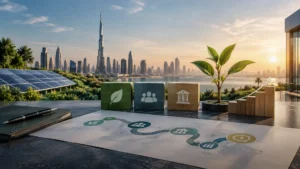
How to Build an ESG Roadmap for Your Business in 2026
Build a practical ESG roadmap for 2026 with clear three-month, six-month and twelve-month actions covering strategy, data, reporting and improvement.

UAE SMEs do not need a large consulting budget, specialist software or a lengthy sustainability report to begin ESG. A practical starting point is to identify the environmental, social and governance matters most relevant to the business, assign responsibility, collect information already available in accounting and operational systems, and select five to ten measurable actions. During the first 30 days, an SME can review electricity and fuel use, document workforce and safety practices, strengthen basic governance policies and establish an ESG baseline. The objective should be to build a repeatable management process—not imitate the reporting structure of a listed multinational company.
| ESG area | Practical starter action | Simple metric | Likely data source |
| Electricity | Review monthly consumption and identify unusual increases | kWh per month | Utility statements |
| Cooling | Check temperature settings and maintenance schedules | Cooling consumption or cost | Facility records |
| Fuel | Monitor company-vehicle and generator use | Litres per month | Fuel cards and invoices |
| Waste | Separate recyclable materials and reduce unnecessary packaging | Kilograms or collections | Waste contractor |
| Water | Check for leaks and monitor high-use sites | Cubic metres per month | Water bills |
| Workforce | Record employee turnover and training | Turnover rate and training hours | HR and payroll |
| Safety | Maintain an incident and corrective-action register | Number and severity of incidents | Safety records |
| Procurement | Add basic ESG questions to supplier onboarding | Percentage of suppliers screened | Procurement records |
| Ethics | Introduce anti-bribery and conflict-of-interest policies | Employees acknowledging policy | Compliance records |
| Data protection | Review access rights and incident procedures | Incidents and completed reviews | IT records |
| Category | Starter metric |
| Energy | Electricity consumption |
| Fuel | Petrol and diesel consumption |
| Emissions | Basic Scope 1 and Scope 2 estimate |
| Waste | Waste generated or number of collections |
| Workforce | Employee turnover |
| Training | Training hours per employee |
| Safety | Recordable incidents |
| Diversity | Workforce composition |
| Ethics | Confirmed compliance incidents |
| Suppliers | Percentage completing basic screening |
| Period | Main objective | Output |
| Days 1–5 | Establish purpose and ownership | ESG sponsor, coordinator and scope |
| Days 6–10 | Identify priority issues | Short material-issues register |
| Days 11–17 | Collect existing information | Initial ESG baseline |
| Days 18–23 | Select actions and targets | Practical action plan |
| Days 24–27 | Strengthen policies | Core governance documents |
| Days 28–30 | Obtain management approval | Approved baseline and review cycle |
There is no single requirement forcing every UAE SME to publish the same full ESG report. Requirements depend on the business’s activities, regulator, free-zone authority and whether it has been designated under relevant climate-reporting arrangements. Customer, lender and tender requirements may also create commercial reporting obligations.
The cost depends on the company’s size, sites, data availability and objectives. An SME can begin internally using existing invoices, policies and records. Specialist support may be required for regulatory assessment, carbon calculations, formal reporting or assurance.
Useful starting data includes electricity, fuel, water, waste, headcount, employee turnover, training, safety incidents, compliance cases and supplier information. The company should prioritise metrics connected with material risks and customer needs.
Not every SME needs a complete Scope 3 inventory immediately. It should screen relevant categories and identify whether customers, regulators or reporting frameworks require them. Purchased goods, outsourced transport and business travel may be important starting categories.
Yes. A short report can be appropriate where it clearly explains the reporting scope, material issues, metrics, actions and limitations. A concise evidence-based report is more credible than a long document containing unsupported claims.
Build a practical ESG roadmap for 2026 with clear three-month, six-month and twelve-month actions covering strategy, data, reporting and improvement.
UAE : (+971) 52 710 0320 PAK : (+92) 300 2205746 UK : (+44) 786 501 4445
The Binary Tower by Omniyat,
19th Floor, Business Bay
S-25, Sea Breeze Plaza Shahrah-e-Faisal, Karachi
Office#1304, 13th Floor, Al Hafeez Heights, Gulberg III
P.O. Box 71, P.C. 100, Muscat
104 Broughton Lane Salford M6 6FL,
UAE : (+971) 52 710 0320 PAK : (+92) 300 2205746 UK : (+44) 786 501 4445
Office 2102 Al Saqr Business Tower 1, Sheikh Zayed Road
S-25, Sea Breeze Plaza Shahrah-e-Faisal, Karachi
Office#1304, 13th Floor, Al Hafeez Heights, Gulberg III
104 Broughton Lane Salford M6 6FL
P.O. Box 71, P.C. 100, Muscat

Typically replies within a day